Japanese Matcha Bowls That Transform Your Daily Tea Ritual
The first time you pick up a Japanese matcha bowl after years of brewing gongfu tea, it feels almost oversized. If you are used to small Yixing pots, thin porcelain cups, a fairness pitcher that fits neatly in one hand, the chawan asks for a different posture. It sits low and wide in the palm. You do not lift it with fingertips. You cradle it.
That physical difference changes the rhythm of the tea.
In Chinese loose leaf practice, especially gongfu style, most of the attention goes into the sequence. The pot is warmed, the leaves are weighed or judged by eye, water is poured and poured off, the liquor shared into small cups. The vessels are many, each with a defined role. A matcha bowl carries the entire preparation inside itself. Powder, water, whisk, and then drinking, all in one body of clay.
Because of that, the bowl has to do more than hold liquid. Its interior curve matters. If the bottom is too flat, the whisk scrapes and clicks instead of gliding. If the well at the center is too deep, foam gathers unevenly and the tea pools in a way that feels awkward on the last sip. A good bowl has a subtle rounding that guides the chasen without resistance. You can feel when the bamboo tines move smoothly, almost cushioned by the clay beneath.
The walls are usually thicker than a porcelain gaiwan, and that thickness serves a practical purpose. Matcha is made with water that is hot but not boiling, and the bowl should not cool it too quickly. At the same time, the rim cannot be so thick that it feels blunt on the lip. When you drink from a chawan, you do not sip cautiously from a tiny edge. You turn the bowl slightly and drink more directly. The contact between lip and glaze is noticeable. Some rims are gently rolled, some left slightly uneven. That slight irregularity can be pleasant. It reminds you that the bowl was shaped by hands, not pressed into a mold and refined to symmetry.
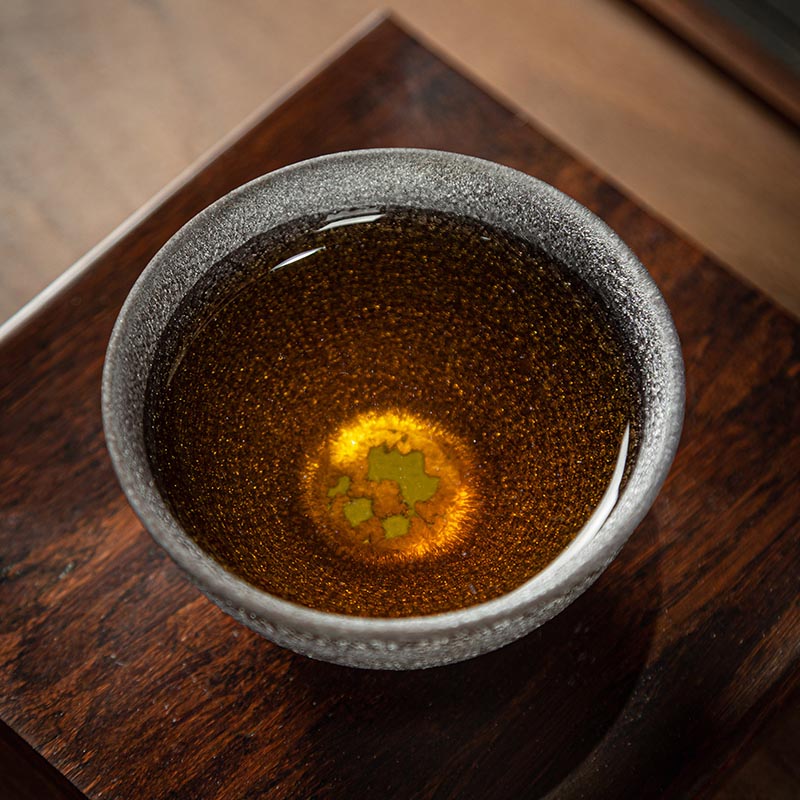
In Chinese ceramics, especially in porcelain cups from Jingdezhen, the refinement often shows in thinness and clarity. Light passes through the walls. The glaze is even and luminous. A matcha bowl, particularly one in the Raku tradition or in a more rustic stoneware, leans in the opposite direction. The clay body might be coarse. The glaze may pool thickly in some areas and thin at the lip. There can be small pinholes, iron specks, subtle warping at the foot. None of this is decorative in a showy way. It affects how the bowl feels after dozens of uses.
Unglazed areas, often at the foot ring, develop a softness over time. The more you handle the bowl, the more the surface seems to settle. It is not the same patina that Yixing clay develops after years of brewing oolong, where the surface grows slightly lustrous from absorbed tea oils. A matcha bowl does not absorb in that way. But repeated rinsing, drying, turning in the hand leaves a quiet trace. The glaze loses a bit of its initial sharpness. The foot ring feels smoother against the tea mat.
There is also the matter of weight. A bowl that looks similar on a shelf can feel completely different in use. Too light, and it feels fragile, almost insubstantial when you whisk. Too heavy, and your wrist tires quickly, especially if you are preparing several bowls in a row. The balance point is low. When you lift it to drink, the weight gathers in the palm rather than pulling forward. You notice this only after making matcha regularly. It is the kind of detail that separates something admired from something used.
From the perspective of a Chinese tea drinker, the lack of a lid or spout is striking. We are accustomed to judging a teapot by how it pours, whether the stream is steady and clean, whether the lid stays seated with a fingertip over the air hole. With a matcha bowl, there is no pour to evaluate. The craftsmanship reveals itself in stillness instead of movement. The bowl must sit stable on the tray. It must not wobble. The foot ring should be trimmed cleanly so it does not scratch the surface beneath. When you set it down after whisking, the sound should be soft and grounded, not sharp and hollow.
Cleaning is straightforward but not careless. Matcha stains lightly over time, especially in lighter glazes. A pale interior will slowly take on a faint green cast if you use it often. Some people are bothered by that. I am not. Tea leaves their trace on most things. Porcelain tasting cups also show a faint line where liquor repeatedly meets the rim. A bowl that remains perfectly white after years of use often means it has spent more time on a shelf than in the hand.
There is a difference in social use as well. Gongfu tea is easily shared. A small pot yields multiple infusions, and everyone receives the same liquor from the fairness pitcher. Matcha is usually prepared one bowl at a time. Even in a small gathering, the bowl is made, presented, drunk, then rinsed before the next. The bowl becomes momentarily personal. You see its interior closely. You rotate it before drinking, as is customary, and that small turn gives you time to notice the glaze pattern, the way the foam sits against the wall, the slight dip where the potter’s thumb once pressed from the outside.
I find that this directness changes attention. With loose leaf tea, my focus often rests on aroma, on how the leaves open in the pot, on the evolving taste across infusions. With matcha, the attention shifts to texture. The thickness of the liquid, the density of the foam, the temperature held by the clay. The bowl frames all of that. Its width determines how the tea spreads as you drink. Its depth controls how much aroma rises at once.
For someone rooted in Chinese tea practice, bringing a matcha bowl into the cabinet does not feel like stepping into another world. It feels more like adding a different instrument to a familiar room. The concerns remain practical. Does it feel right in the hand. Does it function well. Does it invite repeated use.
After a while, you stop thinking about national categories. There is just the bowl you reach for when you want powdered tea instead of leaves, the one whose rim fits your mouth comfortably, whose weight your wrist knows. It sits on the tray beside a Yixing pot and a porcelain cup without argument. Each asks for a slightly different gesture. Each, in its own way, shapes how you pay attention.