A Small Cast Iron Teapot Transforms Your Daily Tea Ritual
A small cast iron teapot changes the feel of a tea table the moment you set it down. Even before water goes in, you sense the weight. It sits with a kind of gravity that porcelain and most clay do not have. When you lift it, even empty, your wrist registers the density. Once filled, the motion of pouring becomes deliberate. You do not flick this pot lightly the way you might a thin-walled gaiwan.
In Chinese tea practice, cast iron is not traditional in the way Yixing clay or Jingdezhen porcelain is, but it has found a place on many tables, especially among people who brew darker teas or who appreciate the way iron holds heat. The small size matters. A large cast iron kettle is one thing, meant to boil water. A small cast iron teapot, sized for gongfu brewing, is another. It asks to be handled carefully, to be poured in short, steady arcs rather than dramatic tilts.
The heat retention is the first thing you notice in use. With a small cast iron pot, the water inside cools slowly. When brewing shu puer or a heavily roasted oolong, that steady heat can be useful. The leaves stay open. The infusion remains stable across short steeps. You do not feel the temperature drop between the first and third pour the way you sometimes do with thinner porcelain. At the same time, you have to pay attention. If you let the leaves sit even a little too long, the heat can push the extraction further than you intended.
Most small cast iron teapots used for tea rather than boiling water are enamel-lined. That lining changes the experience. You do not season it the way you would a raw iron kettle. You cannot rely on the metal to interact with the water in any meaningful way. Instead, it behaves more like a very heavy porcelain vessel with a textured exterior. The inside is smooth and dark, easy to rinse clean, but you do have to be gentle. Metal tools will scratch it. A soft cloth or just a thorough rinse is enough.
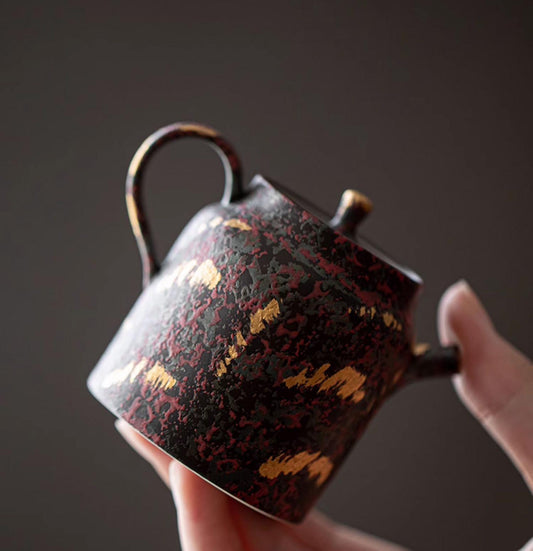
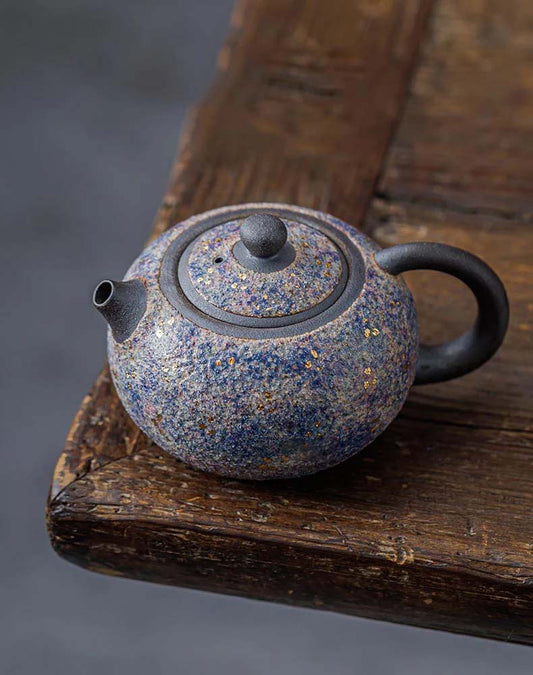
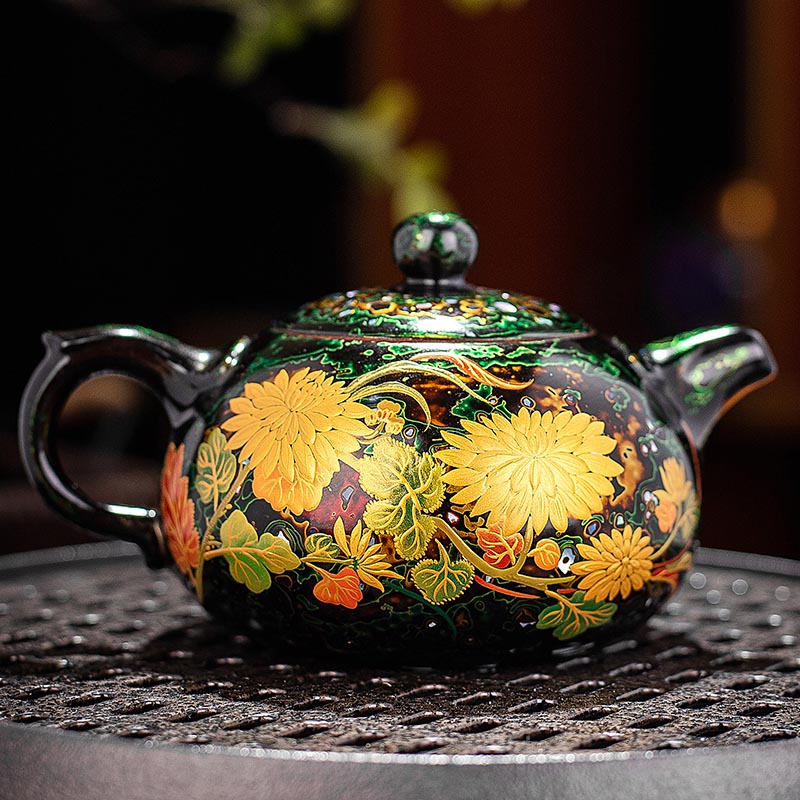
The exterior is where cast iron shows its character. The surface may be studded, ridged, or left with a fine sand texture. Under soft light, the matte black has depth, especially when a little steam settles on it. After months of handling, the high points on the lid knob and the curve of the handle begin to take on a slight sheen. It is not a dramatic patina like Yixing clay developing luster from tea oils, but it is there. The iron responds to touch in a quieter way.
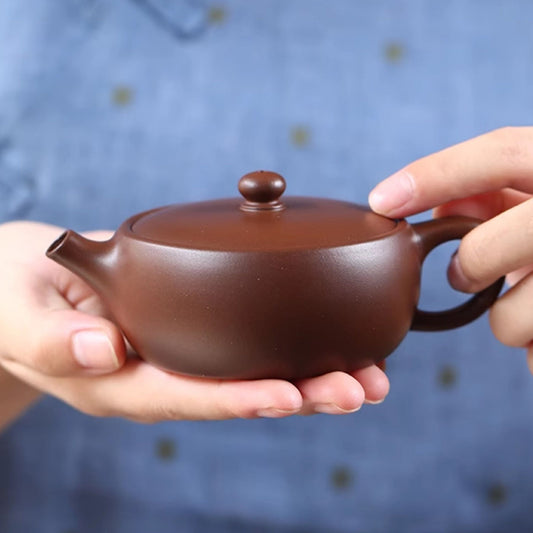
Functionally, the spout tells you whether the pot is worth keeping on your table. Because the body is heavy, balance matters. When you tilt the pot, the center of gravity shifts quickly. A well-made small cast iron teapot will have a spout aligned cleanly with the body, so the stream is direct and steady. If the spout is even slightly off, you feel it immediately in your wrist as you compensate. The best ones pour in a smooth column with very little dribble at the end. The lid should sit firmly enough that you can hold it in place with a finger without fear of it slipping when the pot is fully inverted.
The handle is another practical detail. Some are fixed, some are hinged. A hinged handle that moves too freely can rattle when you pour, a small but distracting sound during a quiet session. A fixed handle feels more stable but can make cleaning slightly awkward. With such a dense vessel, comfort matters. If the handle is too thin or poorly shaped, the weight of a full pot becomes uncomfortable quickly.
In a gongfu setting, a small cast iron teapot often sits alongside lighter pieces. A porcelain fairness pitcher, thin cups, perhaps a clay tea tray beneath. The contrast is part of its appeal. When you lift the iron pot and pour into a glass or porcelain cha hai, the sound is lower, more solid. When you set it down, it meets the tray with a muted thud rather than a click. It changes the acoustics of the table in subtle ways.
There are practical realities. Cast iron stays hot long after the tea is poured. If you are brewing multiple rounds, the body can become too hot to touch comfortably near the base. You learn to grip the handle confidently and avoid the sides. After the session, you dry it carefully. Even with an enamel lining, the rim and lid edge are often bare iron. Leaving moisture there can lead to rust spots. It is not difficult to care for, but it does not forgive neglect.
I do not reach for a cast iron teapot every day. For green tea or lightly oxidized oolong, I prefer the responsiveness of a gaiwan or a thin clay pot where I can feel the temperature drop more quickly and adjust in real time. But for certain teas, especially on cold mornings, the weight and heat of a small cast iron pot feel appropriate. The tea stays warm in the cups a little longer. The brewing rhythm slows slightly because it has to.
Over time, you begin to recognize the small signs of familiarity. The lid settles into place with a soft, confident sound. The handle warms in your hand but does not burn. The pour becomes predictable, the arc of the stream consistent. It stops being a novelty material and becomes simply another tool, heavier than most, steady and dependable.
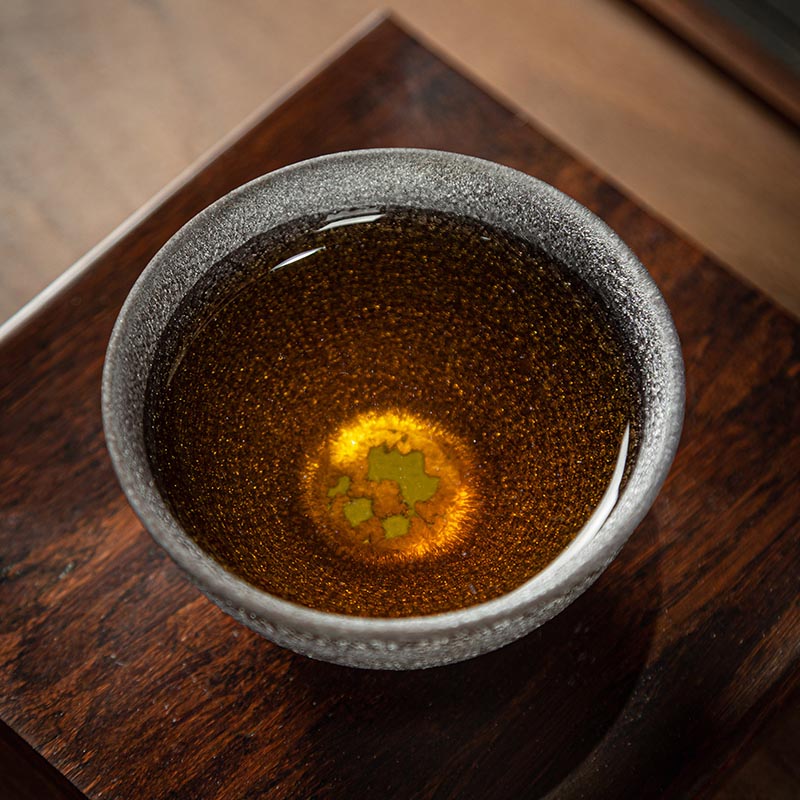
On a shelf, a cast iron teapot can look severe, almost too stark. On the table, filled with steam and used repeatedly, it softens. The texture catches droplets. The dark surface frames the pale foam of freshly poured shu puer or the deep amber of roasted oolong. It does not ask for admiration. It asks to be lifted carefully, poured with intention, dried thoroughly, and put back in its place, ready for the next session.