A Star Teapot Design Shapes Heat, Grip, and the Perfect Pour
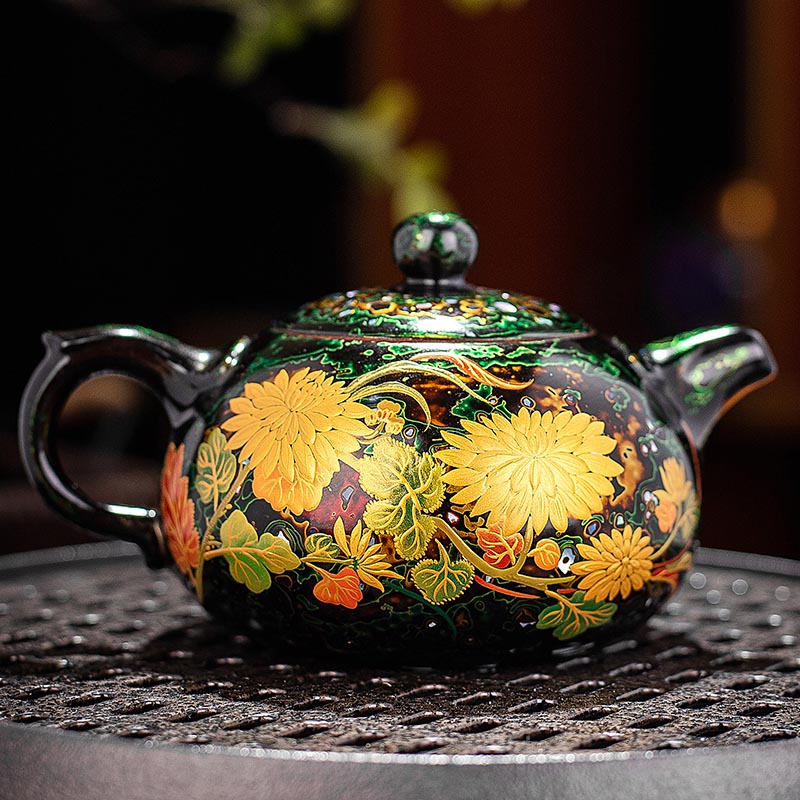
A star teapot usually catches your eye before you even touch it. The body swells outward in soft ridges, five or six lobes pressing gently against the curve so the pot feels like it’s holding its own quiet geometry. From above, the lid mirrors that shape, each point aligning with the body beneath it. It is not a loud design, but it has presence. Even on a crowded tea tray, it doesn’t disappear.
In the hand, the form makes more sense than it does on a shelf. Those lobes are not sharp. They create shallow valleys where your fingers settle when you lift the pot. With Yixing clay especially, the surface has a faint dryness, a texture that meets the skin instead of sliding under it. When the pot is filled and warmed, the heat spreads along those ridges in an uneven way. The high points cool slightly faster than the recessed curves. It is subtle, but if you brew often enough you start to notice how your grip adjusts without thinking.
The craftsmanship shows most clearly in the lid and the spout. On a well-made star teapot, the lid is cut to echo the body’s facets exactly. Turn it slowly and you can feel the faint resistance where clay meets clay, then the soft click as it settles into alignment. During pouring, that fit matters. With gongfu brewing, especially for oolong or sheng puer, you want a quick, clean pour. If the lid is even slightly off, the flow can break or dribble along one of the ridges. A good star pot pours in a single steady arc, the stream rounding out just past the tip of the spout, without splashing. When you tip it back upright, the last drop pulls cleanly inward.
Because of its shape, a star teapot often has slightly thicker walls than a simple round form. That changes how it behaves with heat. For roasted oolong, that extra mass can be helpful. The pot holds temperature through short, repeated infusions. With greener teas, you may need to adjust, shorter steeps, a little less leaf, perhaps a slightly cooler rinse, because the clay retains warmth longer than you expect.
Visually, the star form plays with light in a quiet way. Unglazed zisha clay deepens in tone where it has been handled most. Over months of brewing, the high ridges polish first. They take on a low sheen from oils in the hand and from the tea itself. The recessed lines stay matte longer, holding their original texture. That contrast gives the pot more character than it had when it was new. It stops looking like a shaped object and starts looking like something that has been used.
I have found that the star form encourages a certain attentiveness when arranging a tea tray. The points create orientation. You place the pot so one ridge faces forward, or so the spout aligns with a valley. It is a small act, but it brings awareness to proportion. Paired with a simple porcelain fairness pitcher and thin cups, the teapot becomes the visual center without dominating. The cups, smooth and round, soften the geometry.
Cleaning a star teapot is no different from other unglazed pots, but the shape makes you careful. When you rinse it, water collects briefly in the shallow grooves near the lid line. You tilt it a little more to empty them fully. Over time you learn the angle that clears everything in one motion. If you are careless and leave moisture there, it dries unevenly and can leave faint marks. They are not harmful, but they show up more clearly on a faceted surface than on a plain round body.
Not every tea suits this shape. For very tightly rolled leaves that need room to unfurl, a wider, simpler pot can feel more forgiving. The star form, depending on how pronounced the lobes are, sometimes creates subtle internal corners where leaves settle. It is not a flaw, just something you work with. A gentle swirl after pouring helps redistribute the leaves before the next infusion.
What I appreciate most about a star teapot is that it bridges decoration and use without tipping too far in either direction. On a shelf, it reads as sculptural. In the hand, it is practical. The geometry is not symbolic in any grand way. It changes how your fingers rest, how heat moves through clay, how light falls across the surface during a late afternoon session. After enough brews, the star shape stops feeling decorative and starts feeling familiar, like the ridged edge of a well-used tool.
When I reach for it, it is usually because I want to pay a little more attention than usual, not in a dramatic sense, just in the way I hold it, align the lid, listen to the pour. The pot does not demand that attention. It simply rewards it.